
What comes along as a congenial, mildly satirical romantic comedy is actually British cinema’s latest effort in imperialist propaganda, updated to the 21st century.
Let’s look at the plot first (SPOILER alert):
A nerdy, unhappy and somewhat obsolete scientist-turned-civil-clerk, fishery expert Dr. Alfred Jones (played by the great Ewan McGregor), is approached by investment capital manager Harriet (Emily Blunt) to take part in an insane project: A rich sheik wants to introduce salmon fishing into his native Yemen – not just for cracks, but for the “sense of humility” it provides.
Since the powers that be, read: The British Government, want a “good news story from the Middle East”, they endorse the enterprise. Kristin Scott Thomas plays cynical but powerful PR agent Patricia, who seems to hold a direct grip on the Prime Minister (of a Labour government, so it seems, since there is loads of talk about “the Party”, a classic anti-leftist meme). Driven by domestic problems and unfavourable superiors, Dr. Jones has no chance but to take part in the endeavour.
It seems to be an exercise in the absurd, but ultimately the film is about the power of faith: A faith in a higher “cause” that elevates the characters of the involved and even sponsors the opportunity to fall in love.
Now, we might waste a bit of time on the representation of characters, nationalities and gender.
The government bureaucrats are, of course, laughing stock. Not so, however, is the British Army: Soldier Robert, Harriet’s love interest, is a slightly clumsy but decent character. She never questions why he goes out into war with a Black Op mission, leaving her in the darkness about his whereabouts and other details. This is the course of war, and even in her grief for the lost soldier she never once questions the meaning of this war. A strong, well-educated (she speaks Cantonese) woman, holding a responsible position within the project, Harriet nevertheless is clearly dependent on the love of this sincere patriot, a dependency she can only overcome when she attaches to another man.
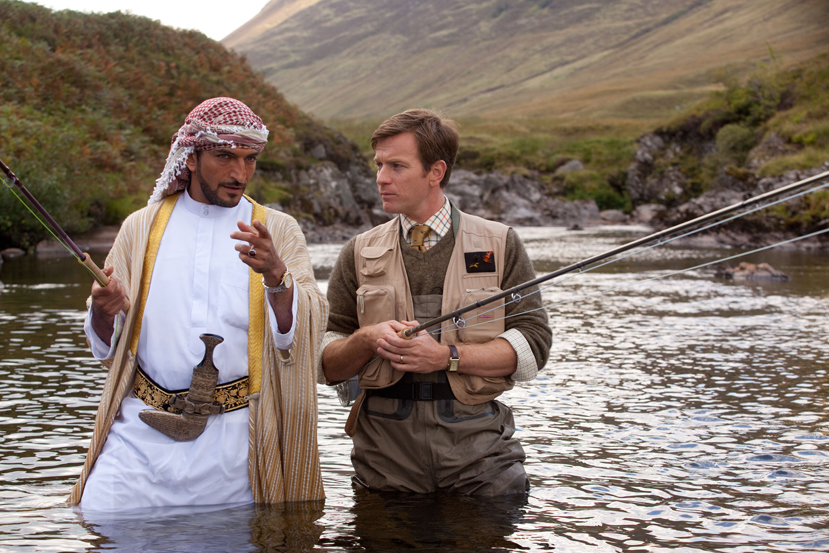
Besides veneration of the military and unbalanced gender roles, there is another, very disturbing streak in the film. Sheik Muhammad (Amr Waked) is portrayed as a just, honorable and faithful man, with a bit of “noble savage” put into the mixture. Notably, this noble sheik has the only speaking role of his ethnicity. There also is a legion of nameless servants (some dressed up fancily in turbans and kilts, perhaps as a marriage of Celtic and Arabic anti-modernism), and the obligatory Islamic terrorists, whose evil deeds are explained as “midunderstanding” of the noble intentions of the semi-westernized sheik. In bad old orientalist fashion, “Salmon Fishing in the Yemen” has earned itself another chapter in “Reel Bad Arabs”, Jack Shaheen‘s account of the racist extravanganzas of Western movies.
Adding injury to insult is at the core of the film, the fantastical project of building a great dam and importing aquaculture salmon into the Yemen. Ecologists would possibly cry out in pain if this was a real project: Introducing a foreign, predatory species into a complex ecosystem of an arid region is nothing less but an environmental crime. Finally, even the unique selling point of the plot is an (eco-)imperialist madness.
Some folks within British cinema still seem to dream of world domination, they do it in style, and the whole thing smells fishy.