
Reported by Sisira Saddhamangala Withanachchi (Future of Food: Journal on Food, Agriculture and Society) and Ankhbold Tsogtbayar (Department of Political Science of National University of Mongolia)
Mongolia is considered a vulnerable country in the climate change scenarios. Currently, Mongolia is covered by around 30% of Gobi desert area. The rest of the country contains semi-arid or arid areas. Geographically, Mongolia is a land-locked country with low precipitation. It is estimated that annual mean temperatures have increased by 2.1°C since the 1940s (Batimaa et al. 2011:2). As a result of climate change, Mongolia experiences extremely cold weather. In the winter period, annual precipitation increases between 12.6% and 119.4%. In the summer period it has warmer weather by which annual precipitation declines from 11.3% to 2.5%. Also, in summer, most of its regions experience 13% to 90.9% increase in evapotranspiration (Batimaa et al. 2011:3). Because of the lack of surface water availability, 80% of drinking water has to be pumped from groundwater sources (Batimaa et al. 2011:2). Due to the impact of climate change in Mongolia, the water availability deteriorates rapidly. Mainly, groundwater resources are over-exploited in the hard winter period (almost seven months in a year), for household consumption, animal husbandry, agriculture and industrial purposes (Tsogtbaatar et al. 2009:30-32).
As a country, Mongolia has rich mineral resources, which are directly used for many industrial products by industries in developed countries. Multinational companies have established mining plants in many parts of Mongolia. Economic liberalization accelerates the trend of investment by foreign mining industries. Nyamosor Tuya (2005) mentions that 60% of industrial output is from mining in Mongolia (Tuya 2005:69: Tsujimura 2007). This mining industry, while boosting the Mongolian economy, affects the ecosystem heavily. It means that the factor for the economic blessing is creating insecure human wellbeing in the country side. Leakage of chemicals and discharging of waste water in surface water and groundwater lead to emerging water pollution and direct effects economic development and human wellbeing (Tsogtbaatar et al. 2009:25-35). In our field research last week with the research team of the National University of Mongolia about Environmental Flow Assessment in the Orkhon River in Mongolia, we interviewed local people, including herders and farmers, and governance officers such as governors, local parliament members, environmental protectors, natural inspectors and water security officers in the river basin.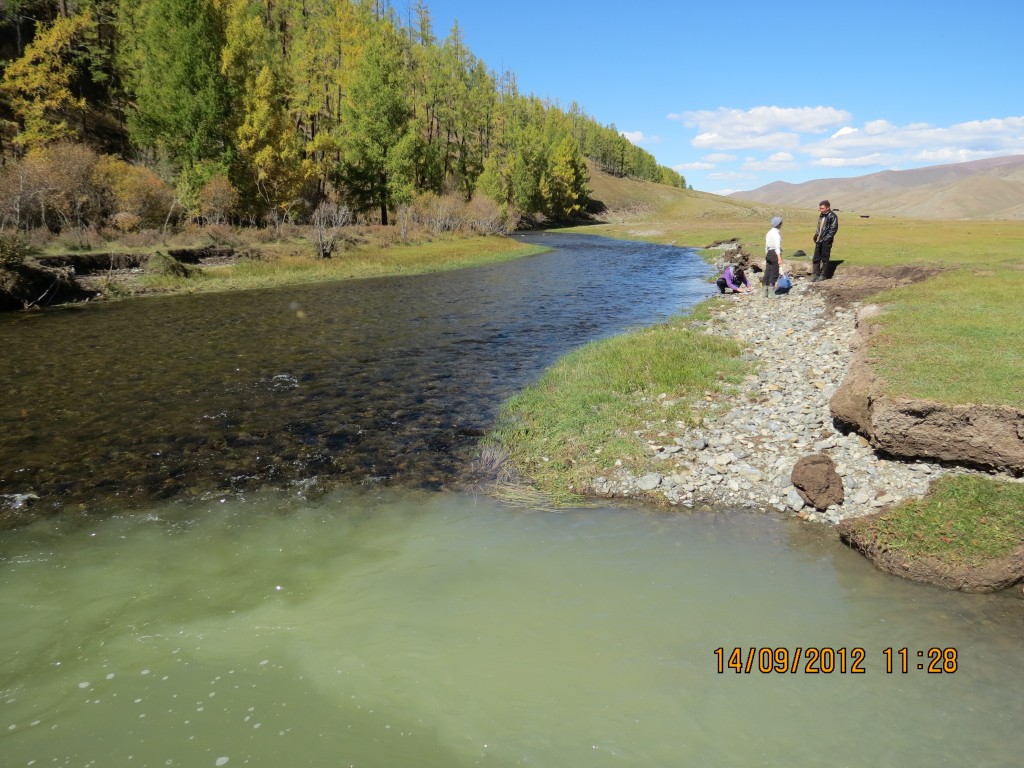
In the first photo, the mixing of the contaminated Orkhon River water with one of tributary of the main Orkhon River can be viewed. This water is being polluted by the mining industries in the upper catchment areas of the Orkhon River. The mining industry was started in 1993. Most of them were given license by Aimag Government without proper Environmental Impact Assessment and without people’s hearing. We were not allowed to enter to the upper mining industry (see second photo). 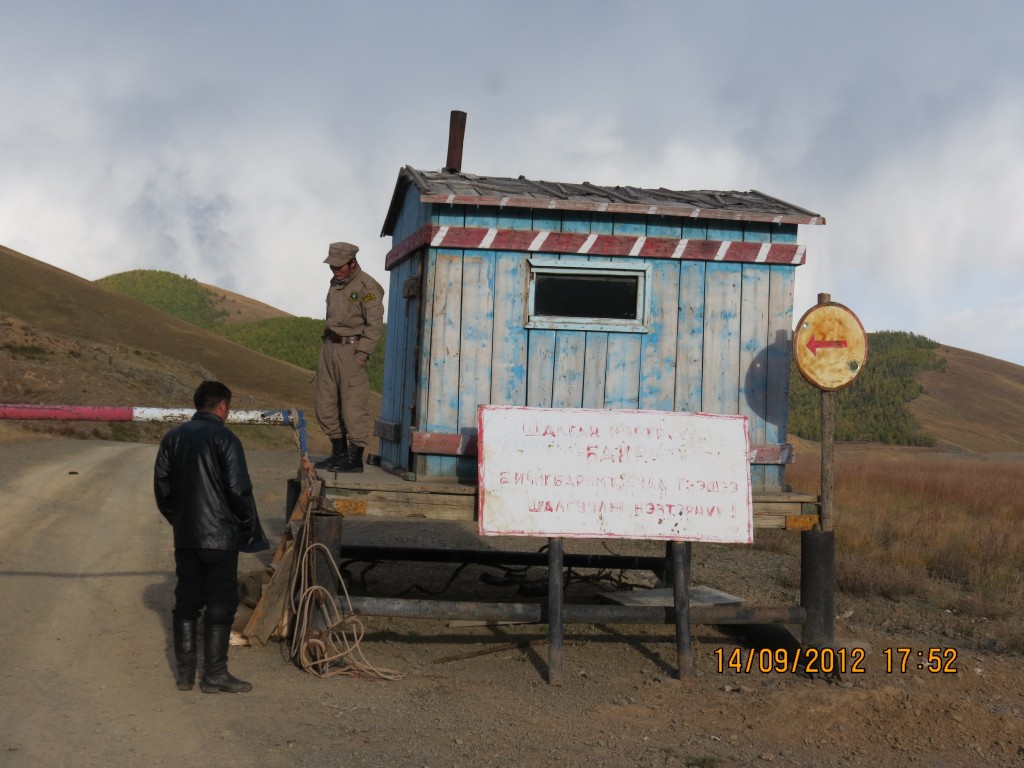 This mining industry is located directly on the natural source of Orkhon River. Local people express their concern about arbitrary mining industries activities. They always struggle with these companies. They told us that these lands belong to them and they do not want to escape from their homeland. We can be witnesses on how these companies block the natural water flow and by washing mining material with arsenic and other chemicals. The local people living downstream and governors also complain that the extremely bad situation of poisoning the Orkhon River Water leads to the decrease of water quality. The speaker of local council of Olziyt Sum clearly reveals that many local people get sick e.g. from rashes on the body due to usage of the contaminated Orkhon River water. Orkhon River water is one of main sources of the water recharging of groundwater (Aquifer). Due to this fact, the quality of groundwater is also threatened by the contaminated river water. This is a dilemma of local water governance issue. Many local governance stakeholders are concerned about the lack of proper attention on effective water management at local level displayed by Aimag and the Central Government in Mongolia.
Another threat is decreasing water quantity as a result of climate change. It is a significant factor when comparing local people views about water quantity over last 20 years. However, the local people’s right to drink pure water, to food security and the right to secure their homeland are being violated in these areas as the negative consequences of arbitrary and profit-oriented mining industry. Now the opportunity is being given to new Democratic and Green Party alliance Government, called “Justice Coalition” in Mongolia. People in Mongolia are waiting what it meant by real Justice: real human wellbeing with environmental protection? Otherwise, Multinational Companies and local mining companies get rich by giving little compensations to Mongolian people, a practice which is highly criticized. Even in the development plan of Mongolia, balanced development with other parts of the country is neglected. The uncontrolled neo-liberal economic policies lead to a development that is confined to Ulaanbaatar alone, the capital which is home to 2/3 of the whole Mongolian population. Also, another issue is that wealth – mainly from mining profits ¬– is accumulated only by the few while the majority of the country is poor. A rhythmic idioms about Mongolia sounds: “Mongolia is not only Ulaanbaatar and is not only few rich people”.
Special thanks to Prof. Dr Soninkhishig Nergui in the Department of the Botany in the National University of Mongolia and the group members in the field work group.
Sources:
Batimaa,P. Myagmarjav B., Batnasan,N. Jadambaa, N., Khishigsurenthe, P. (2011), Urban Water Vulnerability to Climate Change in Mongolia, Water Authority, under the Government of Mongolia
Tsogtbaatar, Jamsran, Janchivdorj, Unurjargal, Lunten Damdinbazar and Erdenechimeg, Badamgarav (2009), The Groundwater Problem in Mongoli, Technical Document in Hydrology | No. 2 UNESCO Office Beijing, 2009, pp.25-38
Tsujimura, Yutaka, Abe Maki, Tanaka, Tadashi, Shimada, Jun,Higuchi, Satoru, Yamanaka, Tsutomu, Gombo Davaa, & Oyunbaatar, Dambaravjaa(2007), Stable isotopic and geochemical characteristics of groundwater in Kherlen River basin, a semi-arid region in eastern Mongolia, Journal of Hydrology, Vol. 333, pp. 47–57